Traveling abroad gives you the chance to do a number of daring things. And whether it’s by using the right utensils for an exotic entrée or the left lane for a drive around town, it’s fun (and occasionally crucial) to tackle new experiences the way the locals do.
This brings us to perhaps the most exhilarating way to try blending in with the locals in a foreign country: communicating! Of course, in places where you know only a few basic phrases, hand gestures are key to getting your message across. … and instead of blending in, you accidentally stir up trouble.
From the unintentionally rude to the patently absurd, hand gestures abroad can say something entirely different than they do at home.
1. Thumbs-up
What you’re probably trying to say: “This is how the Fonz would describe your incredible local cuisine!”
What you could accidentally be saying: “I’m not particularly fond of you.
Where this mix-up can occur: In parts of the Middle East, the Mediterranean, Asia, and the Philippines, and Latin America the thumbs-up is a much more aggressive signal than it is in America, similar to our middle finger or Up yours
How to atone for your mistake: With a gift-wrapped DVD box set of Happy Days.
2. High five
What you’re probably trying to say: “Great job,” “Hello,” “Hold on,” or “Talk to the hand.”
What you might accidentally be saying: “Talk to the hand” (present day).
Where this mix-up can occur: Greece. While the open palm has gone out of style as a sassy gesture here in the U.S., it’s still going strong in this Mediterranean hub. And, although not quite as inflammatory as in Greece, the open palm could also spell trouble in parts of the Middle East and Africa.
How to atone for your mistake: Fist bump.
3. Peace sign
What you’re probably trying to say: “Peace” (obviously).
What you could accidentally be saying: Er, “Not peace.”
Where this mix-up can occur: This can be a very insulting hand gesture in places like the U.K., Ireland, New Zealand, and Australia, but only when the palm faces inward, an error famously committed by Winston Churchill.
How to atone for your mistake: Become the most revered prime minister and inspirational leader the offended country’s ever seen (still, that might be too little too late).
4. Beckoning finger
What you’re probably trying to say: “Come here a minute.”
What you could accidentally be saying: “Death to you.” (Yikes!)
Where this mix-up can occur: In Japan, Malaysia, Singapore, and some parts of Africa, your casual invitation isn’t what you thought it was.
How to atone for your mistake: Buy them a round once they get over to you.
5. Fingers pressed to your nose
What you’re probably trying to say: “There’s a funky smell in here.”
What you could accidentally be saying: “I don’t trust you.”
Where this mix-up can occur: In southern Italy, something as innocuous as a foul odor can turn into a much deeper issue if you’re not careful.
How to atone for your mistake: Share a juicy page of your diary to show the offended parties they’re back in your inner circle.
6. Pointing
What you’re probably trying to say: “Do I go that way?”
What you could accidentally be saying: Well … the same thing, just with a whole lot more ‘tude.
Where this mix-up can occur: Many places — probably best to give up this hand gesture anywhere abroad. Using an open hand to motion this way or that is typically a softer, more respectful approach than pointing. Philippines this is reserved for dogs.
7. Horn Fingers:
Here this is for Rock On but in Italy, Brazil, Portugal, Spain this is a signal that your wife is cheating on you.
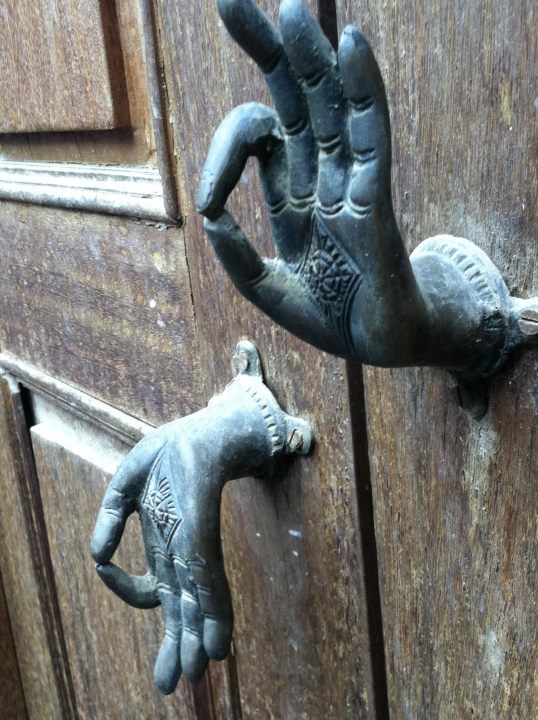
8. OKay
Brazil this is equivalent to the one finger salute especially when turned up side down.
9. Chin Flick:
Most countries see this as get lost including France and Belgium but in Italy it means I don’t give a damn.
When all else fails signal the bartender to get a round of drinks… Now that is universal!
 BOOM-A-RANG MOM